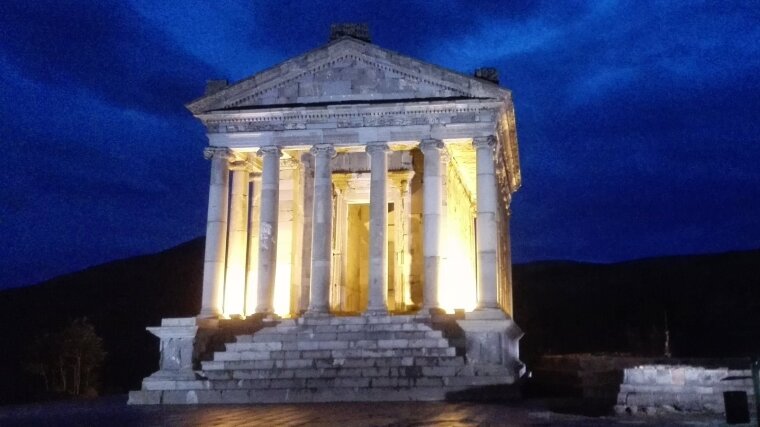
Temple of Garni (Armenia)
26–27 November 2025: Workshop Geopolitical shifts and domestic reconfigurations in the South Caucasus
Location: Centre for East European and International Studies (ZOiS Berlin)
This workshop brings together researchers, policymakers, and regional experts to examine how ongoing geopolitical shifts are reshaping political, social, and infrastructural developments in the South Caucasus. Over two days, participants explore the region’s evolving relationship with the European Union, the impact of changing global power dynamics on national alliances and major infrastructure projects, and the ways in which civil society, youth, and religious communities navigate increasing autocratization and shrinking civic space. Through panels and a public roundtable, the program highlights both high-level geopolitical reconfigurations and their lived consequences on the ground, offering diverse perspectives on emerging insecurities, contested visions of the future, and potential pathways for more inclusive and strategically coherent engagement in the region.
Workshop programpdf, 152 kb · de
26 November, 2025: Public Round Table in cooperation with ZOiS (Berlin)
The EU and Germany in the South Caucasus: Arising Insecurities and New Visions?External link
This panel explores how recent geopolitical ruptures and the evolving regional power and security order have reshaped the EU and Germany’s positioning in the South Caucasus.
In the context of a scramble for influence by external powers in the South Caucasus, the panellists will discuss Europe’s capacity to act as a stabilising force and mediator in response to the growing illiberalism and geopolitical tensions in Armenia, Azerbaijan and Georgia. Bringing in perspectives from politics, diplomacy and policy analysis, the session will assess the plausibility of the renewed call for a unified EU strategy towards the region and Germany’s contribution in terms of a more structured engagement.
Moderator: Tiffany G. Williams (Friedrich Schiller University Jena)
Speakers:
- Könül de Moor (International Crisis Group, South Caucasus)
- Franziska Smolnik (German Institute for International and Security Affairs)
- Deren Derya (European External Action Service)
- Robin Wagener (Alliance 90/The Greens, Member of the German Bundestag)
This discussion is part of the semi-public workshop 'Geopolitical Shifts and Domestic Reconfigurations in the South Caucasus'. The event is a cooperation between Caucasus Studies at the Friedrich Schiller University Jena and the ZOiS Caucasus Network.
December 9, 14.00-15.30: Roundtable: Georgia after the parliamentary elections
Location: Kleiner Sitzungssaal, Rosensäle, Fürstengraben 27, Jena
On October 26, parliamentary elections were held in Georgia, widely regarded as fraudulent, resulting in a contested victory for the ruling Georgian Dream (GD) party with an alleged 54% of the vote, granting them the mandate to govern for another four years. The major opposition parties, elected to parliament, chose to boycott their mandates, while President Salome Zourabishvili declared the elections “illegitimate”. Shortly after, Prime Minister Irakli Kobakhidze announced the suspension of Georgia's EU accession talks and the rejection of EU financial aid until 2028. Since then, mass protests have erupted across the country, with people voicing their dissatisfaction to what they call a “pro-Russian” government, and demanding a return to Georgia’s European path, renewed elections or even regime change.How did Georgia arrive at this point, and what are the broader implications of these political decisions for Georgian society and the country's political future? In this roundtable discussion, we aim to place these developments in a larger context by analyzing both domestic and external reactions and decisions which followed the elections. We will focus on four key areas: internal politics, including GD’s political narratives and the governmental-opposition dynamics; the constitutional dimension of the political crisis; the positions of universities and the implications on the scientific community; and finally the EU’s and Russia’s reactions towards the events in Georgia. Our goal is to provide a nuanced understanding of Georgia's political developments at this critical juncture. The discussion will be followed by a Q&A session with the audience.
November 9-10, 2023: Conference South Caucasus after “Zeitenwende”: Dimensions of translocality and societal change
The conference is organized within the framework of the research project entitled, “Resilience in the South Caucasus: prospects and challenges of a new EU foreign policy concept” (JENA-CAUC), funded by the German Federal Ministry of Education and Research (BMBF). The goal of the conference is to unpack the societal, economic, political, and security-related consequences of Russia’s war against Ukraine for the South Caucasus region, and the transformational changes taking place in the region since the war. A Keynote by PD Dr. Tsypylma Darieva from the Centre for East European and International Studies (ZOIS), will open the conference, and it will end with a Round Table discussion on South Caucasus after the “Zeitenwende”The conference will be held on-site. For further information please visit our Facebook page or write an email to jenacauc@uni-jena.de
Conference Programpdf, 347 kb · de
November 3-4, 2022: Conference Bouncing back or moving forward? Contextualizing “Resilience” in the South Caucasus
Tbilisi State University
The conference is organized within the framework of the research project entitled, “Resilience in the South Caucasus: prospects and challenges of a new EU foreign policy concept” (JENA-CAUC), funded by the German Federal Ministry of Education and Research (BMBF). The goal of the conference is to advance the understanding of the resilience concept and its practical application within the context of the South Caucasus. A Keynote by Professor. Elena Korosteleva from the University of Warwick (https://warwick.ac.uk/fac/arts/schoolforcross-facultystudies/igsd/about/people/ekorosteleva/External link), will open the conference, and it will end with a Round Table discussion on regional, national and European identity in the South Caucasus.
The conference will be held on-site. For further information please visit our Facebook page or write an email to jenacauc@uni-jena.de.
Kino Klub Kaukasus
The Institute for Caucasus Studies Jena is continuing the film seminar Kino Klub Kaukasus with a 2021-2022 series on the topic called Contingencies and change in the Caucasus. The seminar features contemporary movies which were produced by young filmmakers from or with relation to the North and South Caucasus. Main themes of the seminar are everyday life, social roles and societal change, labour and socialisation. It is open to students from FSU Jena as well as everyone else interested in the Caucasus. It is a hybrid format and unites virtual and in-person screenings. All screenings are followed by open discussions.
If you want to be part of the seminar, write an e-mail to: caucasus-studies@uni-jena.deExternal link
Please indicate which session you want to join. The number of participants is limited to 25 for every session.
All sessions are moderated by Tamar Khutsishvili and Veronika Pfeilschifter (Institute for Caucasus Studies, FSU Jena). The banner was created by Johanna Preißler (FSU Jena).
Our sessions are as follows:
28 October 2021 (Thursday), 6 pm (CET): No time to retire+A butcher’s daughter (by Leyla Ganbarli, Azerbaijan, online, Q&A with director Leyla Ganbarli)
19 November 2021 (Friday), 6 pm (CET): My Piece of the Earth (by Maka Gogaladze, Georgia, seminar room, Jenergasse 8, FSU Jena)
15 December 2021 (Thursday), 6 pm (CET): Storgetnya (by Hovig Hagopian, Armenia/France, online)
20 January 2022 (Thursday), 6 pm (CET): Дзуар, Святое место, Holy place (by Madina Togolokova, North Ossetia, online, followed by Q&A with Emine Sahingöz)
10 February 2022 (Thursday), 6 pm (CET): The engima of Faina (by Durna Safarova, Azerbaijan, online, followed by Q&A with Durna Safarova)
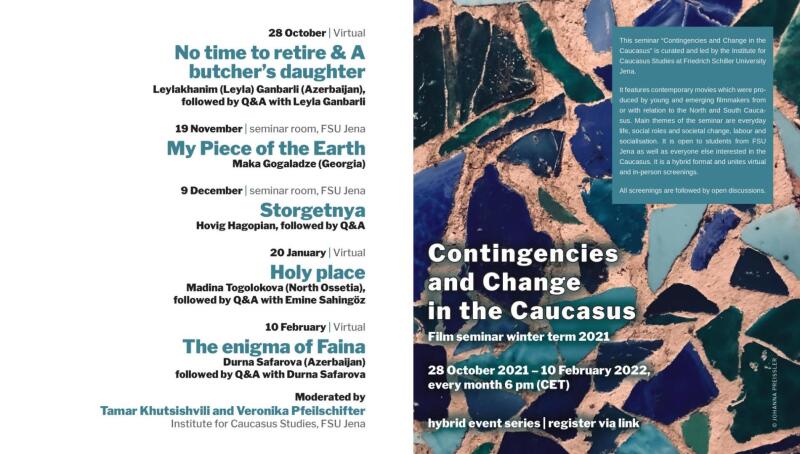
Contingencies and change in the Caucasus
Image: Johanna PreisslerOctober 18 - October 20, 2019: Second International Circassian Conference
Caucasus Studies will participate with a session on the Circassian language in the "Second International Circassian Conference" in Nurnberg, Germany, October 18 - October 20, 2019. The conference is devoted to the Circassian history, culture and language and possible ways of preserving, developing and spreading knowledge about the Circassian people and their rich traditions. There will be a special session about developing teaching materials, enhancing the orthography and language teaching and revitalization chaired by Diana Forker.
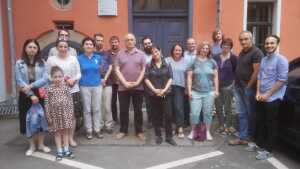
Participants of the Second International LexCauc Workshop
Image: Diana ForkerJune 5-7, 2019, Second International LexCauc Workshop
We hosted the second international LexCauc Workshop. 18 experts of Caucasian languages met in Jena and discussed the lexical database of the Caucasian languages. During the past year they have gathered lexical data of 18 East and West Caucasian languages, which will be included into the database that we are currently building up as part of the LexCauc Project.
The program of the workshoppdf, 388 kb · de
Pictures can be found on our Facebook pageExternal link