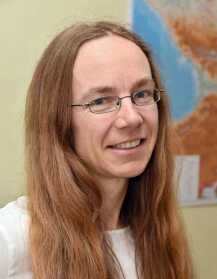
Prof. Dr. Diana Forker
Research & areas of expertise
- East Caucasian (Nakh-Daghestanian) and West Caucasian languages
- language documentation and electronic corpora and dictionaries for minority languages
- language contact, language chance and language history of the Caucasus
- grammatical description and functional linguistics
- sociolinguistics and linguistic anthropology
- language typology and areal linguistics
-
CV
Positions
Since 04/2019
University of Jena, Department of Slavonic languages and Caucasian studies,
full professor08/2016–03/2019
University of Jena, Department of Slavonic languages and Caucasian studies,
Substitute professor (Vertretungsprofessorin)2011–2017
University of Bamberg, Chair of General Linguistics,
Lecturer2013–2014
James Cook University, Cairns Institute,
Feodor Lynen Research Fellow2007–2011
Max Planck Institute for Evolutionary Anthropology, Department of Linguistics, Leipzig,
Doctoral fellow
Fellowships and awards- Georg von der Gabelentz Award (Association for Linguistic Typology)
- Habilitationspreis (prize for the best habilitation) (University of Bamberg)
- Feodor Lynen Research Fellowship of the Humboldt Foundation at the Cairns Institute, James Cook University
- Wilhelm von Humboldt-Preis (German Linguistic Society)
- Otto Hahn Medal (Max Planck Society)
Externally funded projects2025
“Tradition bewahren – Zukunft sichern: nachhaltiges Gestalten des deutsch-georgischen Wissenschaftsnetzwerkes Tbilisi / Jena (DGW)” (39.964,40 Euro, BMBF)2024-2027
BMBF (Forschungsvorhaben auf dem Gebiet der Regionalstudien (area studies) “The South Caucasus after the “Zeitenwende”: from regional resilience to local agency” (Jena-Cauc 2.0) (590.220,53 Euro)
2022-2025
DFG (project partner) “Caucasian narratives in the discourse of comparative fairy tale research”, PI Elguja Dadunashvili2021–2024
BMBF (Forschungsvorhaben auf dem Gebiet der Regionalstudien (area studies) “Resilienz im Südkaukasus: Perspektiven und Herausforderungen des neuen EU-Außenpolitikansatzes” (895.409,09 Euro)2021–2024
Volkswagen Foundation (Between Europe and the Orient – A Focus on Research and Higher Education in/on Central Asia and the Caucasus) “The Caucasus from the perspective of social sciences” (249,800 Euro)2019–2024
DFG (Heisenberg Programm) “Language contact, language history and areal typology in the Caucasus and beyond” (477,000 Euro)2017–2020
BMBF (Kleine Fächer, große Potenziale) “LexCauc - A lexical database for the languages of the Caucasus”, PI Oleg Belyaev & Diana Forker (299,900 Euro)2012–2019
VW Foundation (DoBeS Initiative) “Documenting Dargi languages in Daghestan - Shiri and Sanzhi” (291,000 Euro) visit websiteExternal link
This is my full CVpdf, 235 kb · de -
Teaching and supervision of students
At the FSU Jena I teach courses such as:
- Introduction to Caucasus Studies
- Cultures and ethnic groups of the Caucasus
- Oral Literature and Mythology of the Caucasus
- Contemporary literature of the Caucasus
- South Caucasian Languages
- North Caucasian Languages
- Language, culture and identity
- Linguistic Anthropology
- Language Policy
I supervise BA, MA and PhD students of the Institute of Slavonic languages and Caucasus studies who study and research the Caucasus from anthropological, linguistic, historical or political perspectives.
Supervisory experience:
- PhD dissertation: Veronika Pfeilschifter, Ideological consciousness and resilience: The ‘new’ post-Soviet left in the South Caucasus (Jena, ongoing)
- PhD dissertation: Natia Botkoveli, Resilience of students from Post-Soviet countries (Jena, ongoing)
- PhD dissertation: Rainer Feer, Semantic Transitivity and Ablaut in Circassian and West Caucasian (Jena, ongoing)
- PhD Dissertation: Maximilian Grübsch, A Grammar of Chechen (Jena, ongoing)
- PhD dissertation: Vitalii Shtybin, Virtual Circassia: Networking for a transnational community (Jena, ongoing)
- PhD dissertation: Irena Gonashvili, To What Extent Can the New Global Strategy of the European Union Contribute to the Region-Building in the South Caucasus? (Jena, ongoing)
- PhD dissertation: Felix Anker, Reported speech in Caucasian languages (Jena, 2024)
- PhD dissertation: Tamar Khutsishvili, Land use strategies in an Armenian border village (Jena, 2022)
- MA thesis: Narmin Gurbanova. Study of indigenous rituals in Northern Azerbaijan (2025, Jena)
- MA thesis: Tobias Schneider. Verwandtschaftsbezeichnungen in den Sprachen des Kaukasus (2025, Jena)
- MA thesis: Helmut Sandeck. Inverse Verben im Abchasischen. (2024, Jena)
- MA thesis: Maximilian Grübsch. Georgische Fremdwörter im Tschetschenischen: Gender-Assignment. (2023, Jena)
- MA thesis: Jana Hesina. Sprachliche Ideologie und Identität von russischen Herkunftssprechern in Deutschland. (2021, Jena)
- MA thesis: Khatuna Jashi. Das orthodoxe Christentum im postsowjetischen Georgien: Tradition und Neuheit. (2020, Jena)
- MA thesis: Michael Stürmer. Perzeptionen von Europa und migrantische Strategien georgischer Asylbewerber. (2020, Jena)
- MA thesis (co-supervisor): Julia Schmidt. Nacht und Meer als Sinnbilder der Unendlichkeit in Bunins Lyrik. (2019, Jena)
- MA thesis: Felix Anker. Topological relations in Tsova-Tush. (2019, Bamberg)
- MA thesis: Simone Gasch. Politisierte Kunst und Künstler in Jerewan. (2017, Jena)
- MA thesis (co-supervisor): Steffen Reetz. A quantitative corpus-based analysis of post-predicate goals in spoken Oghuz Turkic varieties. (2015, Bamberg)
-
Publications
Last five years. For preprints and handouts see my Academia pageExternal link
Monographs
- Forker, Diana. 2020. A grammar of Sanzhi Dargwa. Berlin: Language Science Press.
- Forker, Diana. 2013. A Grammar of Hinuq. Berlin: De Gruyter.
Edited volumes
- Forker, Diana & Lenore Grenoble (eds.) 2021. Language contact in the territory of the former Soviet Union. Amsterdam: Benjamins.
- Forker, Diana & Geoffrey Haig (eds.) 2018. Person and gender in discourse: An empirical cross-linguistic perspective. Linguistics 56(4).
- Hannah Sarvasy & Diana Forker (eds.) 2018. Word hunters: Field linguists on fieldwork. Amsterdam: Benjamins.
- Forker, Diana & Timur Maisak (eds.) 2018. The semantics of verbal categories in Nakh-Daghestanian languages: Tense, aspect, evidentiality, mood/modality. Leiden: Brill.
Publications in journals (peer-review)
- Forker, Diana & Natia Botkoveli. 2024. Resilience through language? A case study of three minority communities in Georgia. International Journal of Multilingualism, 1–21. https://doi.org/10.1080/14790718.2024.2328140External link.
- Coventry, K. R., Gudde, H. B., Diessel, H., Collier, J., Guijarro-Fuentes, P., Vulchanova, M., ... Forker, D. & Incel, O. D. (2023). Spatial communication systems across languages reflect universal action constraints. Nature human behaviour, 7(12), 2099-2110. https://doi.org/10.1038/s41562-023-01697-4External link
- Forker, Diana & Natia Botkoveli. 2022. The Impact of Language on Resilience in Minority Communities of Georgia. Caucasus Analytical Digest 127, 9–15.
- Barth, D., Evans, N., Arka, I. W., Bergqvist, H., Forker, D., Gipper, S., Hodge, G., Kashima, E., Kasuga, Y., Kawakami, C., Kimoto, Y., Knuchel, D., Kogura, N., Kurabe, K., Mansfield, J., Narrog, H., Pratiwi, D. P. E., van Putten, S., Senge, C. & Tykhostup, O. 2022. Language vs. individuals in cross-linguistic corpus typology. Language Documentation and Conservation (25), 179-232.
- Forker, Diana. 2021. General linguistics and the nature of human language. Theoretical Linguistics 47(1–2), 61–74.
- Forker, Diana. 2021. Complexity and its relation to variation. Frontiers in Psychology 6. doi: 10.3389/fcomm.2021.632468
- Forker, Diana. 2020. The late success of Soviet language policy. International Journal of Bilingualism. DOI: 10.1177/1367006920947168
- Forker, Diana. 2020. Elevation as a grammatical and semantic category of demonstratives. Frontiers in Psychology 11. doi: 10.3389/fpsyg.2020.01712
- Forker, Diana. 2020. More than just a modal particle: The enclitic =q'al in Sanzhi Dargwa. Functions of Language 27(3), 340-372.
- Forker, Diana. 2019. Elevation as a category of grammar: Sanzhi Dargwa and beyond. Linguistic Typology 23(1), 59–106.
- Forker, Diana. 2019. Reported speech constructions in Sanzhi Dargwa and their extension to other areas of grammar. Sprachwissenschaft 44(2), 171-199.
- Forker, Diana. 2019. The impact of language contact on Hinuq: Phonology, morphology, syntax, and lexicon. Language Typology and Universals 71, 29–62.
- Forker, Diana. 2019. Sanzhi-Russian code switching and the Matrix Language Frame Model. International Journal of Bilingualism 23(6) 1448–1468
Publications in collective volumes (peer-review)
- Forker, Diana. 2024. Postpredicate elements in Adyghe (West Caucasian). In Geoffrey Haig et al. (eds.) Post-predicate elements in the Western Asian Transition Zone: a corpus-based approach to areal typology. Berlin: Language Science Press, 305–331.
- Forker, Diana. 2024. Postpredicate elements in Kartvelian and East Caucasian. In Geoffrey Haig et al. (eds.) Post-predicate elements in the Western Asian Transition Zone: a corpus-based approach to areal typology. Berlin: Language Science Press, 279–303.
- Forker, Diana. 2024. Clause chaining in Adyghe. Sarvasy, Hannah S. & Alexandra Y. Aikhenvald (eds.) Clause chaining in the world’s Languages. Oxford: Oxford University Press, 576–602.
- Forker, Diana & Ala Al Sheshani. 2023. Far beyond the Caucasus: Chechen in contact with Jordanian Arabic. Nataliya Levkovych (ed). Diversity in Contact. Berlin: De Gruyter, 111–144.
- Forker, Diana. 2023. Emphatic reflexive particles in Nakh-Daghestanian languages. In Ioana Nechiti & Thede Kahl (eds.) Ethno-Cultural Diversity in the Balkans and the Caucasus. Wien: Österreichische Akademie der Wissenschaften., 369–384.
- Forker, Diana & Victor Friedman. 2023. The Caucasus. In Martin J. Ball & Rajend Mesthrie (eds.) The Routledge Handbook of Sociolinguistics around the World, 2nd edition. London: Routledge.
- Forker, Diana & Lenore Grenoble. 2021. Introduction. In Forker, Diana & Lenore Grenoble (eds.) Language contact in the territory of the former Soviet Union, 1–13.
- Forker, Diana & Lenore Grenoble. 2021. Some structural similarities in the outcome of language contact with Russian. In Forker, Diana & Lenore Grenoble (eds.) Language contact in the territory of the former Soviet Union, 259–287.
- Comrie, Bernard, Diana Forker & Zaira Khalilova. 2021. Antipassives in Nakh-Daghestanian languages: Exploring the margins of a construction. In Janic, Katarzyna & Alena Witzlack-Makarevich (eds.) Antipassive. Typology, diachrony, and related constructions. Amsterdam: Benjamins, 515–578.
- Forker, Diana. Avar. 2021. In Polinsky, Maria (ed.) The Oxford Handbook of Languages of the Caucasus. Oxford: Oxford University Press, 243–279.
- Forker, Diana. 2021. Information structure in Caucasian languages. In Polinsky, Maria (ed.) The Oxford Handbook of Languages of the Caucasus. Oxford: Oxford University Press, 871–900.
- Forker, Diana & Felix Anker. 2019. Bridging constructions in Tsezic languages. In Valérie Guérin (ed.) Bridging constructions. Berlin: Language Science Press, 99–128.
- Forker, Diana. 2019. Grammatical relations in Sanzhi Dargwa. In Alena Witzlack-Makarevich & Balthasar Bickel (eds.) Argument Selectors: A new perspective on grammatical relations. Amsterdam: Benjamins, 69–106.
Electronic Publications & Community Materials
- Forker, Diana. 2019. Sanzhi Dargwa dictionary. Dictionaria 5, 1–5533. (https://dictionaria.clld.org/contributions/sanzhiExternal link).
- Diana Forker & Gadzhimuard Gadzhimuradov. 2017. Sanzhi tales and legends. With a Sanzhi-Russian and a Russian-Sanzhi dictionary. Makhachkala. [In Russian]